
One in four (23%) adults in the world smoke tobacco, and 1.3 billion tobacco users live in low-and middle-income countries.
In rich countries, smoking increased, peaked, and then declined over a century. A long path with serious health consequences, therefore, this timescale should be taken into account by low-to-middle income countries in order to avoid the magnitude of the health consequences seen in rich countries. Considering this, they must act quickly to reduce tobacco consumption.
Strategies for surveillance and monitoring of consumption of tobacco products are relevant actions for tobacco control. This includes the regular collection of data on the magnitude, patterns, determinants, and consequences of the consumption of tobacco products and the passive exposure to residues resulting from their consumption.
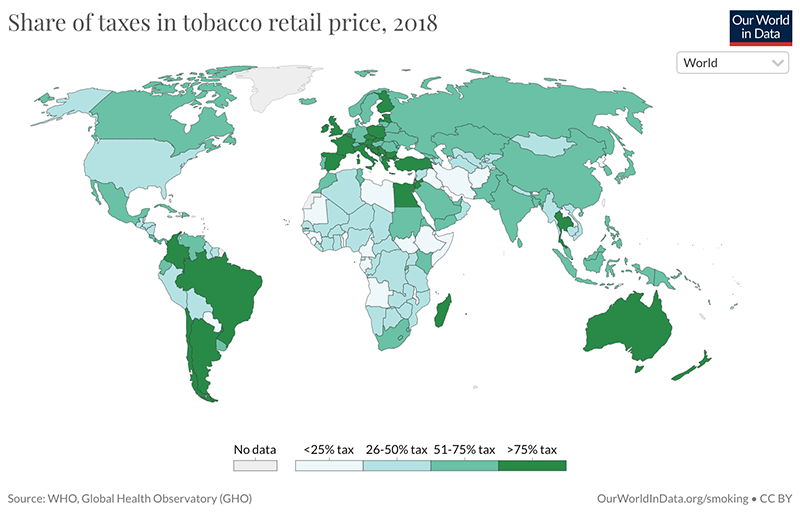
Taxation is the least expensive way to reduce tobacco consumption
According to the annual Global Burden of Disease study, 8.7 million people die prematurely from tobacco use every year; 7.6 million of those deaths are the result of smoking, and nonsmokers account for 1.3 million of those who die as a result of second-hand smoke exposure. Moreover, it contributes to poverty by diverting household spending from basic needs.
There is no safe level of exposure to tobacco, and all forms of tobacco are prejudicial. Cigarette smoking is the most prevalent type of tobacco use globally. Waterpipe tobacco, various smokeless tobacco products, cigars, cigarillos, roll-your-own tobacco, pipe tobacco, bidis, and kreteks are some other tobacco products.
According to WHO, tobacco taxes are the most cost-effective way to reduce tobacco use and health care costs, especially among youth and low-income people, while also increasing revenue in many countries. The tax increases should be sufficient to cause prices to increase faster than income growth.
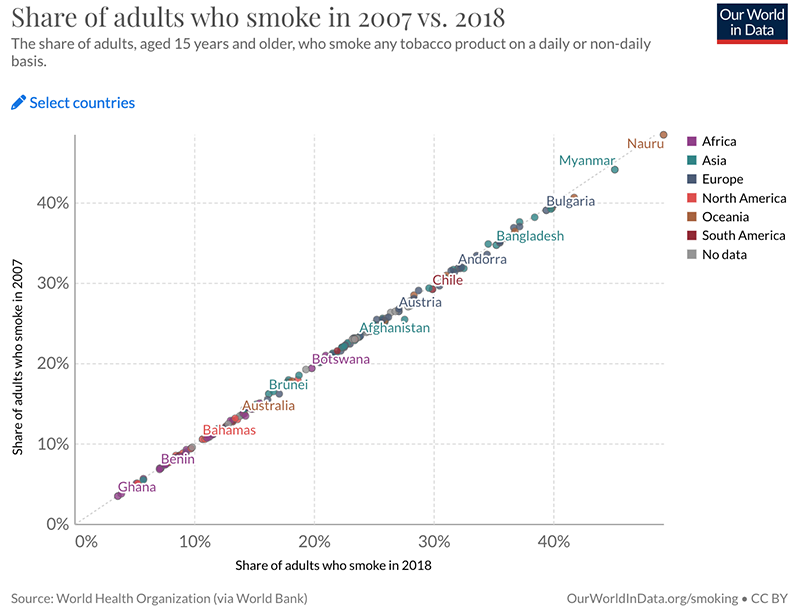
The Asia Pacific has the highest rate of smoking-related deaths
There are several countries where at least 40% of the population smokes, if not more. People who smoke are concentrated in two regions: Southeast Asia and the Pacific Islands, and Europe.
The factor which influences the prevalence of smoking is prosperity. If we look at the relationship between smoking prevalence and income, we find that richer countries tend to smoke more, but this has been changing in the last decades.
In the article “Burden of smoking in Asia-Pacific countries”, 2021, Asian countries are in the first phase of the tobacco smoking epidemic.
The projected prevalence of consuming tobacco products among males aged 15 years in 2020 was: 40.2% in Malaysia, 39.7% in Thailand, 46.9% in South Korea, 28.3% in Singapore, 14.3% in Australia, and 10.0% in Hong Kong.
Africa’s low-income countries have the heaviest smokers
According to the Southeast Asia Tobacco Alliance, the prevalence rate of tobacco smoking in Africa is only 14%. Its growth is modest compared to the Americas (23%), but its growth is the highest in the world.
Mozambique, for example, has seen a 220% growth in cigarette consumption over the past 16 years. Moreover, the continent has the highest ranked smoker countries on the planet, with Tunisia’s estimated at 1,628 cigarettes per adult per year, or about 4.4 per day for each person over 18 years old. Egypt and Libya are second and third, respectively. Also, currently, 90% of Africans are unprotected by smoke-free laws.
Brazil and Turkey are role models in the fight against smoking
Brazil and Turkey are the only two countries among the 171 nations that have adhered to the World Health Organization’s global measures.
According to the 7th WHO Report on the World Tobacco Epidemic, released in 2019, Brazil ranks second in the world in the fight against tobacco use.
Brazil and Turkey have reached the highest level of the six Mpower measures (a plan to reverse the tobacco epidemic). They are as follows: monitoring tobacco use and prevention policies; protecting people from smoking; providing assistance in quitting smoking; warning about the dangers of tobacco; enforcing bans on tobacco advertising, promotion, and sponsorship; and raising tobacco taxes.
Data from the Ministry of Health shows that in the last 13 years, the population interviewed decreased tobacco consumption by 40%.
The survey also reveals that consumption has been falling in all age groups: from 18 to 24 years old (12% in 2006 and 6.7% in 2018); 35 and 44 years old (18.5% in 2006 and 9.1% in 2018); and between 45 and 54 years old (22.6% in 2006 and 11.1% in 2018). Among women, the reduction in smoking reached 44%.
The government’s efforts to end smoking in Brazil began in the 1990s when professionals from states and municipalities were trained to treat patients in the Unified Health System (SUS) in more than 4,000 health units throughout the country. The SUS offers free treatment for those who want to stop smoking, including the drug bupropion, patches, and chewing gum (nicotine replacement therapy). In 2018, more than 134, 000 people were treated.
Another point that contributed to the reduction of tobacco consumption in Brazil was the creation of free and national telephone service for the population to ask questions, Dial Sade 136. In Brazil, taxes on tobacco products reached 83% in 2018, up from 57% in 2008.
