
Pakistan’s startup funding numbers do not immediately suggest one of the world’s most exciting technology markets.
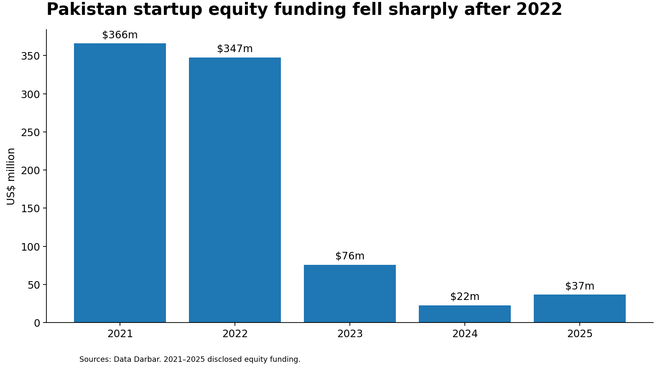
After peaking at almost $366 million in 2021 and remaining close to $350 million in 2022, disclosed equity investment in Pakistani startups fell to just $75.8 million in 2023 and $22.5 million in 2024. Funding recovered modestly to $36.6 million in 2025, but remained far below the highs of the early 2020s.
Look beyond venture capital, however, and a more interesting picture emerges.
Pakistan has a sizeable software export industry, fast-growing digital payment infrastructure, more than 160 million broadband subscribers and an ambitious national AI programme. It also has something fintech companies tend to find particularly interesting: a large population for whom access to formal financial services remains limited.
That creates an unusual combination. The infrastructure is becoming increasingly digital, while many of the products that could run on top of it have yet to reach much of the population.
And that may tell us more about Pakistan’s technology opportunity than the size of its latest venture round.
Pakistan is not simply a smaller India
One of the most useful points investor and adviser Alexander Piskunov made when I spoke to him for Emerging Markets Today was that Pakistan should not be approached as a smaller version of neighbouring India.
The distinction matters for startups.
India’s enormous domestic market allows a technology company to become very large before it seriously considers international expansion. A startup can build a substantial customer base at home, raise money from a relatively deep domestic investment ecosystem and potentially achieve unicorn scale without making overseas markets central to its early strategy.
For ambitious Pakistani technology companies, the international question can arrive much earlier.
That changes the job of the founder.
A company selling internationally must think about issues such as where it is incorporated, how overseas customers will pay, which jurisdiction governs its contracts, how it provides support across markets and how a foreign investor can participate in the company.
This can be a disadvantage. It creates complexity earlier.
But it can also create a different kind of company. A Pakistani startup that cannot depend entirely on its domestic market may have to think internationally from almost day one.
That is particularly relevant to software, where Pakistan already has years of experience supplying services to customers overseas.
The VC recovery needs some context
Startup investment has begun to show signs of life again.
According to i2i Ventures, Pakistani startups raised $133.7 million across ten deals during the first nine months of 2026.
At first glance, that sounds like a dramatic comeback.
But the headline number needs qualification. One company, Fasset, accounted for around 91% of the $74.7 million raised during Q3. Fasset is also headquartered in the UAE, although i2i includes it because Pakistan is an important part of its strategy. Excluding Fasset, Q3 funding was around $6.7 million.
That is a useful illustration of why startup funding figures can be misleading.
A handful of large transactions can make an ecosystem appear much healthier than the underlying availability of early-stage and follow-on capital suggests.
There are also differences between datasets. Some trackers focus on disclosed equity investment, while others include debt or hybrid funding. Comparing annual headline totals without checking the methodology can therefore give a distorted picture.
The more durable question is not whether Pakistan can produce one or two large funding rounds.
It is whether founders can repeatedly move from idea to product, customer, funding and scale.
And for that, venture capital is only one piece of the infrastructure.
Pakistan’s digital economy is much larger than its startup funding totals
The broader technology economy already operates at a very different scale.
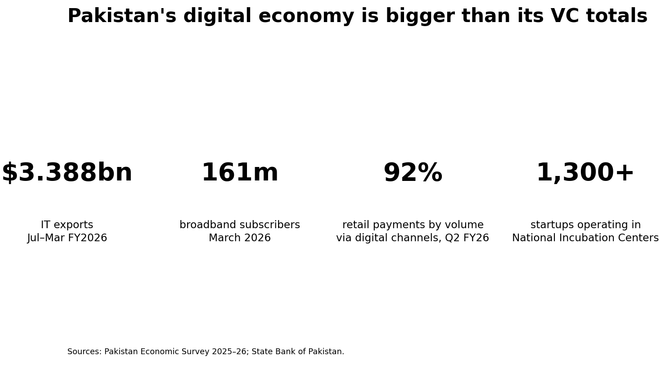
Pakistan’s Economic Survey reported more than 30,000 registered IT and IT-enabled services companies as of March 2025. During the first nine months of FY2025, ICT service exports reached $2.825 billion, up 23.7% from the same period a year earlier.
By July to March of FY2026, IT exports had climbed to approximately $3.388 billion.
Broadband subscriptions reached 161 million by March 2026, while more than 1,300 startups were operating through the country’s National Incubation Centers.
This matters because Pakistan’s technology story is partly a startup story, but it is also an export story.
A software engineer or technology services company working with clients in the Gulf, Europe or North America may never appear in venture-capital statistics.
Yet that experience can create something valuable for the next generation of founders: knowledge of international customers.
Services companies learn what customers complain about, which processes are expensive, what takes too long and what businesses are prepared to pay to fix.
The opportunity is turning some of that knowledge into repeatable products.
That transition is not automatic. A software company that customises its product for every customer can quickly find itself running a services business under a SaaS label.
But the underlying international experience gives Pakistan an interesting starting point.
Fintech may be the clearest example of the opportunity
Nowhere is the gap between infrastructure and adoption more visible than in financial services.
Pakistan’s payment system has digitised remarkably quickly.
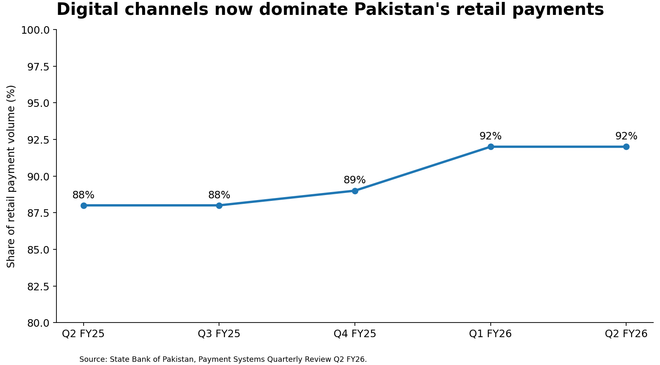
According to the State Bank of Pakistan, digital channels accounted for 92% of retail payment transactions by volume during October to December 2025, up from 88% a year earlier.
That share remained at 92% during January to March 2026, when digital channels processed around 3.4 billion transactions worth PKR 68.3 trillion.
Mobile banking apps and digital wallets are a major part of the shift.
Raast, Pakistan’s instant payment system, is becoming increasingly important as well. During January to March 2026 alone, Raast processed around 742 million transactions worth PKR 23.27 trillion, while the number of merchants onboarded or registered for its person-to-merchant services had passed 2.6 million.
Those numbers matter, but not because payment volume alone proves that Pakistan has achieved financial inclusion.
It has not.
What they show is that much of the underlying infrastructure needed to build new financial products is becoming available.
That changes the fintech question from simply:
How do we digitise a payment?
to:
What can be built once digital payments are normal?
That could include merchant tools, SME finance, savings products, lending, insurance, cross-border services and new forms of embedded finance.
Digital payments are not the same as financial inclusion
Pakistan illustrates an important distinction that is sometimes lost in discussions about fintech.
A country can have rapidly modernising payment infrastructure while large parts of its population remain outside the formal financial system.
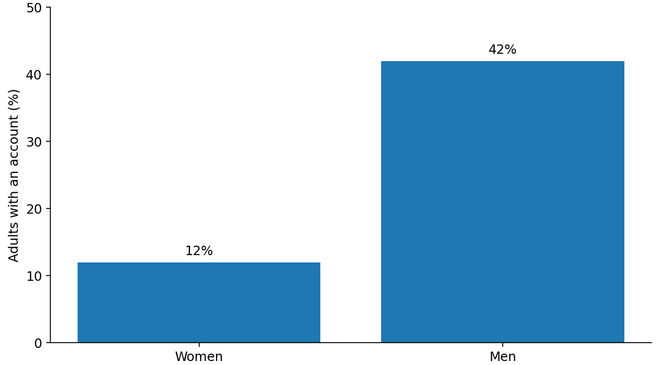
World Bank Global Findex data show that only 27.3% of Pakistani adults had an account in 2024.
The gender gap is particularly striking.
Around 42% of men had an account, compared with only 12% of women.
[VISUAL 4: Pakistan account ownership gender gap]
From a development perspective, that is a major challenge.
From a fintech perspective, it also illustrates the size of the population that existing financial products have not yet reached effectively.
The opportunity is therefore not simply another digital wallet.
The more interesting businesses may be those able to use increasingly sophisticated payment rails to solve harder problems around access, credit, savings, merchant finance and small-business services.
There is also another dimension that receives less attention internationally: Islamic finance.
Pakistan’s position as a large Muslim-majority market means fintech products designed around Islamic financial principles could potentially have relevance beyond Pakistan, including in the Gulf and Southeast Asian markets such as Indonesia.
That makes Islamic fintech interesting not only as a domestic financial-inclusion story, but potentially as an export story.
AI policy is ambitious. Execution will matter more.
Artificial intelligence is the other area where Pakistan’s ambitions are becoming increasingly visible.
The government approved its National Artificial Intelligence Policy on 31 July 2025.
Among other measures, the policy calls for a National AI Fund, a network of AI Centres of Excellence and stronger links between universities, industry and startups.
Importantly, the policy explicitly identifies commercialisation as part of the problem.
The National AI Fund is intended to support research, development and commercialisation, while Centres of Excellence are supposed to provide access to computing infrastructure, laboratories, startup support and connections between researchers and the private sector.
The government has since expanded its ambitions. In 2026 it outlined plans for a $1 billion commitment to AI through 2030, alongside large-scale training programmes and AI hubs.
Those are significant ambitions.
But announcing an AI strategy is easier than building an AI economy.
The harder part sits between research and revenue.
A university team can produce promising research. A founder can build an impressive prototype. Neither automatically becomes a company customers are willing to pay.
That commercialisation gap matters particularly in ecosystems where private early-stage capital, experienced startup operators and corporate buyers are less abundant.
The most useful government intervention may therefore be less about trying to predict which AI technology will win and more about helping researchers and founders cross that gap.
Research → prototype → customer → repeatable product → scale
Each arrow represents a different problem.
Funding is one of them.
Access to data, computing infrastructure, customers, sales expertise and experienced management matter too.
Pakistan does not need its own version of every global AI company
This also points to a more realistic way of thinking about Pakistan’s AI opportunity.
Trying to reproduce every major Silicon Valley AI company locally is unlikely to be the most productive strategy.
Applied AI may be much more interesting.
Which expensive or slow business processes can be automated?
Can document review be faster?
Can multilingual customer service become cheaper?
Can AI improve workflows in industries where Pakistani software companies already have international clients?
Can a local company solve a problem well enough that the product works for a customer in Karachi, Dubai or London without the founder having to personally explain every demonstration?
Those questions are less glamorous than announcing the next foundational model.
They are also much closer to how durable technology businesses are built.
What international investors actually want to know
Pakistan’s international image inevitably affects how some overseas investors initially perceive its companies.
But founders cannot control every political or economic headline.
They can control much more basic things.
Where is the company incorporated?
Who owns the intellectual property?
Where are customer contracts held?
Can international customers pay easily?
Are customers renewing?
Can the company retain its key employees?
What happens when it needs another funding round?
These may sound like administrative details beside an exciting product demonstration.
For an investor, they are part of the product.
Piskunov’s advice to founders is therefore relatively practical: do not spend an entire investor meeting arguing about perceptions of Pakistan. Bring the conversation back to the business.
Show the customers.
Show who is paying.
Show whether they renew.
Show how the company will scale.
That advice applies well beyond Pakistan.
The companies to watch may already think internationally
This brings us back to the difference between Pakistan and much larger domestic markets.
The companies with the best chance of breaking out internationally may be those that treat global expansion not as the final stage of growth, but as part of the company’s design.
Software is an obvious candidate because the product can travel relatively easily.
Applied AI can build on that software and services base.
Fintech offers a large domestic problem set, increasingly sophisticated payment infrastructure and possible opportunities in other Muslim-majority markets.
None of these guarantees Pakistan will produce the next major emerging-market technology hub.
There are still significant constraints, including the availability of capital, financial inclusion gaps, macroeconomic risk and the difficult transition from technical talent to scalable product companies.
But looking only at annual venture-capital totals misses much of what is changing underneath.
Pakistan already has a substantial technology services sector.
Its digital payment infrastructure is scaling.
Its government is investing in AI capabilities and commercialisation.
And many of its most ambitious founders have a structural reason to think beyond their home market earlier than companies in larger economies.
The real question is therefore not whether Pakistan can produce startups.
It already does.
The more interesting question is whether its technical talent, digital infrastructure and increasingly international outlook can be converted into companies that repeatedly win customers, attract capital and scale beyond Pakistan.
That will tell us far more about the future of Pakistan’s technology ecosystem than the size of any single VC round.
Listen to the conversation
This article draws on my conversation with investor and adviser Alexander Piskunov on Emerging Markets Today, where we discussed Pakistan’s startup ecosystem, AI policy, international investment, fintech, financial inclusion and what Pakistani companies need to scale globally.
Listen to the full episode:
https://podfollow.com/emerging-markets-today
Watch and read on Substack:
https://emergingmarketstoday.substack.com/
This article is for informational purposes only and does not constitute investment advice.
