
Every day, millions of Indonesians open an app, tap “buy” and become part-owners of the country’s biggest companies. It looks like financial inclusion in action. But a simpler question rarely gets asked: who is on the other side of the trade?
In October 2026, Indonesia’s stock market crisis made that question hard to ignore. On 16 October, the Jakarta Composite Index fell 8% at the open, triggering a trading halt, and closed down 11.57%, its worst day since 1998. The trigger was not a recession or a bank failure. It was index provider MSCI proposing to strip Indonesia of its emerging-market status, citing opaque shareholding structures and suspected coordinated trading.
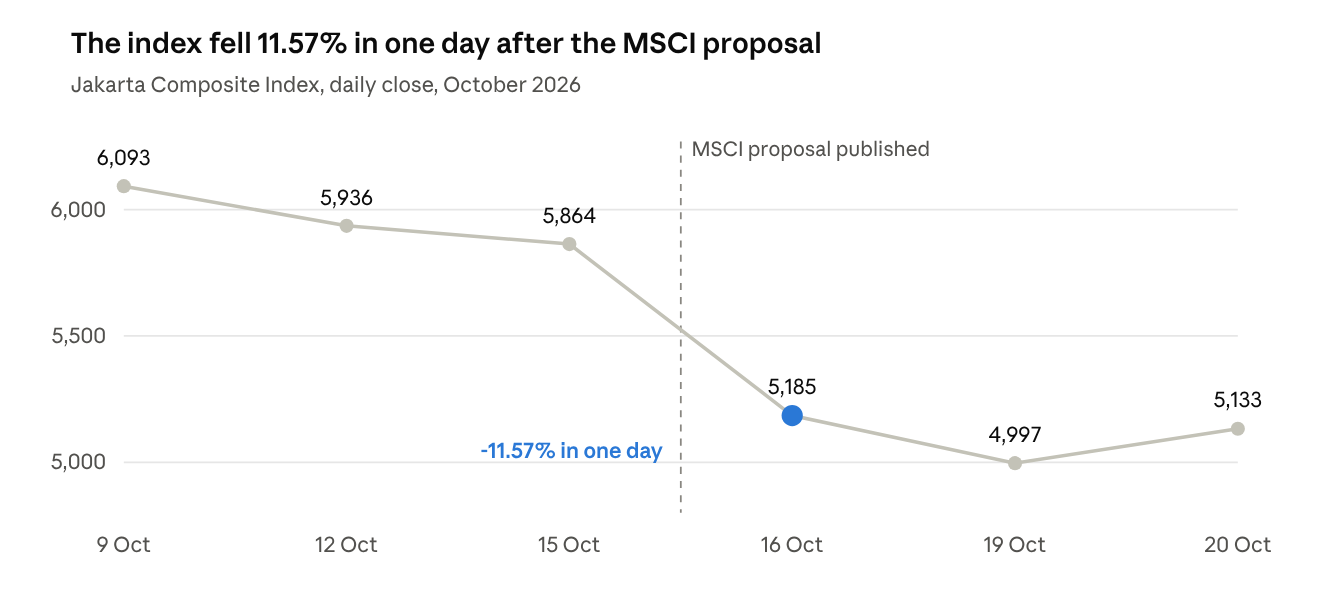
Source: Daily closes from Suara Garut (9 Oct), Kompas.com (12 Oct), Investing.com (15 Oct), ANTARA (16 Oct), Suara Independent (19 Oct) and Trading Economics (20 Oct, approximate)
The fall came after weeks of decline: the index had already slipped below 6,000 before MSCI’s announcement.
Indonesia’s Retail Investor Boom: Millions Enter the Stock Market
Indonesia has built one of the fastest-growing investor bases anywhere. By the end of October 2026, the country had 33.55 million capital market investor accounts, up from 32.17 million a month earlier, and more than 80% of investors were aged 40 or younger. It counts everyone registered to invest in mutual funds, government bonds or shares, and mutual funds drove most of the growth. Only about 8 million Indonesians hold stocks directly. Even so, retail investors accounted for roughly half of daily stock trading in 2025, and 55% in September 2026.
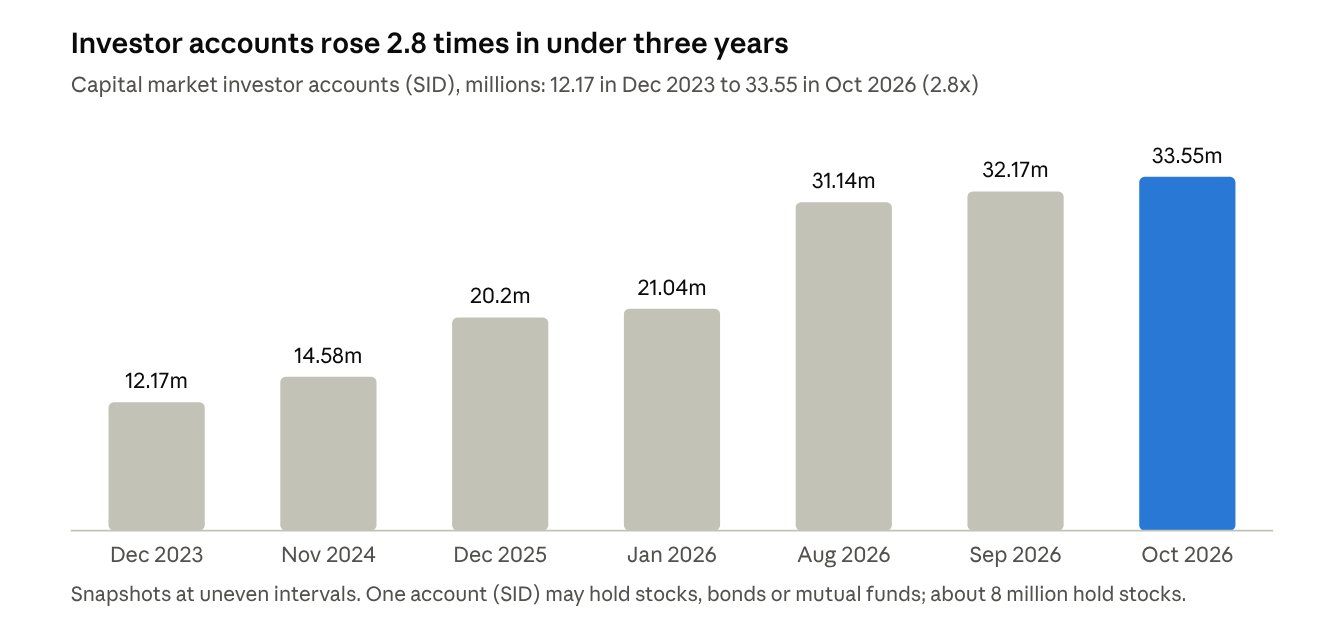
Source: KSEI via Neraca (2023, 2024); OJK via Kompas.com (2025); IDX via Databoks (Jan 2026); OJK via IDX Channel (Aug and Sep 2026); OJK via ANTARA (Oct 2026); stock investor count via Pikiran Rakyat.
But headcount is not wealth. Data from Indonesia’s securities depository show that Gen Z and millennial investors make up the large majority of accounts, yet baby boomers, fewer than 3% of investors, hold more than twice as much in assets. The market’s newest participants are many, young and small.
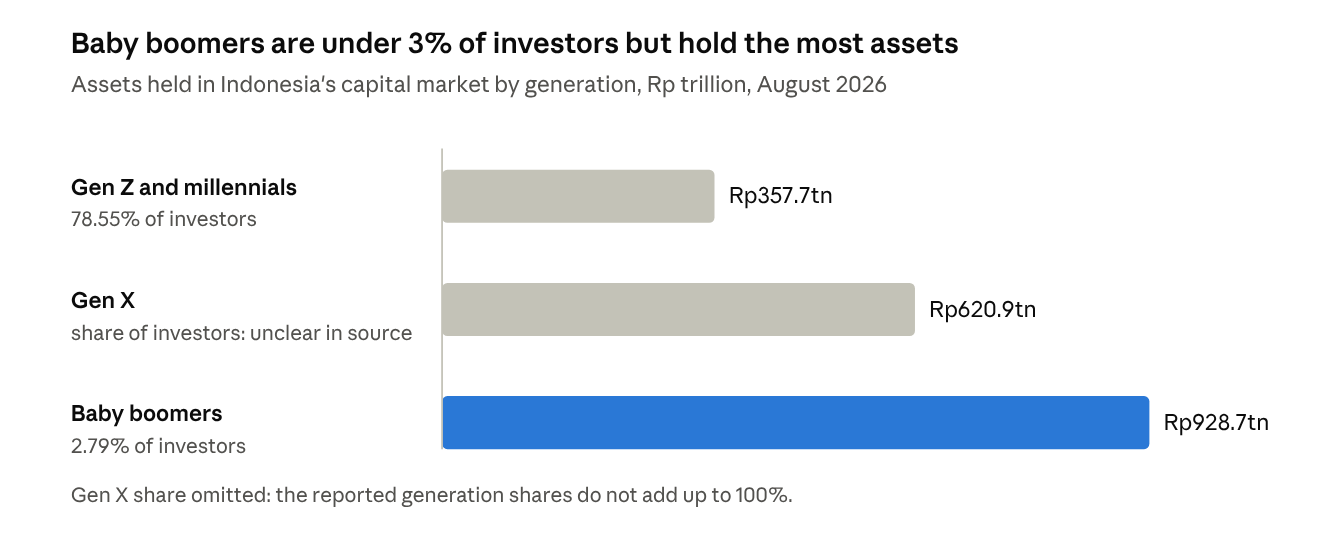
Source: Indonesian Central Securities Depository (KSEI) data, August 2026, reported by ANTARA
Behind those numbers are people like Edo, a 32-year-old who started investing in 2025 using information from digital media and social platforms. He told Tirto.id he panicked on 16 October, refreshing his trading app every minute while searching for news. Eki, a more experienced investor, saw his portfolio fall by as much as 40% in October, with some smaller-company holdings down as much as 80%. Others are waiting it out. Hasbi, 26, who has traded since 2020, told Kompas his portfolio had fallen by up to 25%.
A survey of 1,250 people, carried out on 21 October, adds scale. Of the 314 respondents who held shares the day before the crash, about 30% said their portfolio had lost 5–10% since 15 October. Most did not trade at all, and 43.63% said anxiety had them opening their investment apps more often than usual.
Has Investor Protection Kept Pace With Indonesia’s Digital Investing Boom?
Indonesia’s investor boom has been built on phones: trading apps, investment content on social media, and sign-ups that take minutes. Understanding has not grown at the same pace. In the regulator’s 2025 national survey, capital market literacy stood at just 17.78%, one of the lowest scores of any part of the financial sector.
Information often comes from the same feeds as the hype, as Edo’s experience shows. Regulators know it: in February 2026, OJK said it was examining 32 capital market cases involving parties ranging from corporations to influencers. The tools that drew millions into the market have moved faster than the rules meant to protect them once they are in.
What Is Free Float, and Why Does It Matter for Indonesia’s Stock Market?
MSCI’s concern centres on free float: the share of a company’s stock actually available for the public to trade. When insiders control most of the shares, and some “public” shares are quietly held by parties linked to them, a narrow group can move prices. Indonesians have a name for stocks pumped this way: saham gorengan, or “fried stocks.”
The pattern is not new. In 2020, clients of the financial planning firm Jouska lost money on shares it had recommended. The Asabri scandal cost the state Rp22.78 trillion of pension money belonging to soldiers and police. And in October 2026, the regulator OJK said IPO shares in two Barito Group companies had been allocated to parties linked to controlling shareholders under disguised identities, and found structured manipulation in a Sinar Mas-linked stock. Fines totalled about Rp2.1 trillion.
In each case, the buyers at the top had the least information: retail clients, small investors, a pension fund.
Foreign Investors vs. Retail Investors: Who Can Afford to Exit?
Here lies the asymmetry: foreign investors can sell and leave. Yet the numbers show less of an exodus than the headlines suggest. The value of foreign holdings in Indonesian stocks nearly halved in 2026, from about $250 billion to $130 billion, but net foreign selling from January to mid-October was only about $5.1 billion. In other words, less than 5% of that $120 billion fall was money leaving; the rest was falling share prices and a weaker rupiah. Foreign ownership slipped only from 27% to 25% of the market.
Selling did speed up after the MSCI announcement: foreign investors sold a net Rp16.88 trillion of Indonesian shares in October alone, as the index fell 16.7% for the month. Still, what matters is the option to leave. Domestic retail investors have no other home market to move to.
Who Lost the Most Money in Indonesia’s Stock Market Crash?
In money terms, most of the market does not belong to small investors. In October alone, the total value of shares listed in Jakarta fell by Rp1,833 trillion (about $100 billion), from Rp10,695 trillion to Rp8,862 trillion. At the end of September, individuals held only 18.1% of the value of shares in the central depository and foreign investors 39.7%; domestic institutions such as companies, banks, insurers and pension funds held the rest.
The biggest individual losers are the families who control the largest listed companies. According to the Bloomberg Billionaires Index, five tycoons and their families lost about $57 billion between MSCI’s first warning in January and 22 October, wiping out four years of gains; the three richest lost $5.9 billion in two trading days after the October announcement. That is more than ten times the roughly $5 billion foreign investors sold this year to mid-October. Much of this wealth is on paper, and it sits in the same tightly held stocks MSCI has questioned: two of the three companies OJK fined on 16 October belong to the Barito Group of energy tycoon Prajogo Pangestu, one of the five.
So the real asymmetry is not who lost the most money, but who can absorb it. Individuals make up more than 99% of investor accounts. A tycoon’s paper fortune can recover with the next rally; a fund manager reports a bad quarter. For a 26-year-old with a few years of savings in shares, the same fall can be a large part of everything they own. No public data yet show how big these losses are relative to people’s savings, and that is where the real hardship would appear.
What Would an MSCI Downgrade to Standalone Status Mean for Indonesia?
MSCI sorts the world’s stock markets into four groups: developed, emerging, frontier and standalone. Large index funds track these groups, so when a market moves category, funds that follow the index have to sell. A standalone market sits outside MSCI’s main indexes altogether, alongside countries such as Argentina, Lebanon and Palestine.
That gives a private company enormous power: its classification can move a national market more than company earnings do. Yet these are judgements, not facts. Rival index provider FTSE Russell kept Indonesia in its emerging category earlier that month.
How Is Indonesia Responding to the Stock Market Crisis?
Indonesia’s response has been fast. Authorities are excluding stocks with highly concentrated ownership from the main index and expanding shareholder disclosure. Some moves even raise their own questions. Prominent Instagram influencers attended a regulators’ meeting on the crisis, to the surprise of some attendees. The sovereign wealth fund Danantara said it was ready to buy shares, though one official insisted the aim was not to stabilise the market. A state fund buying shares in its own subsidiaries may calm prices, but it does not make ownership any less concentrated.
It is also worth noticing the timing. Reform accelerated when foreign money threatened to leave, not when local investors were burned in earlier scandals.
Can Indonesia Restore Investor Confidence Before MSCI’s 2027 Decision?
MSCI will announce its decision by June 2027. Whatever it decides, the more important test is whether Indonesia’s market becomes fair for the millions who stay. More than 300 listed companies still fall short of the new 15% free-float minimum.
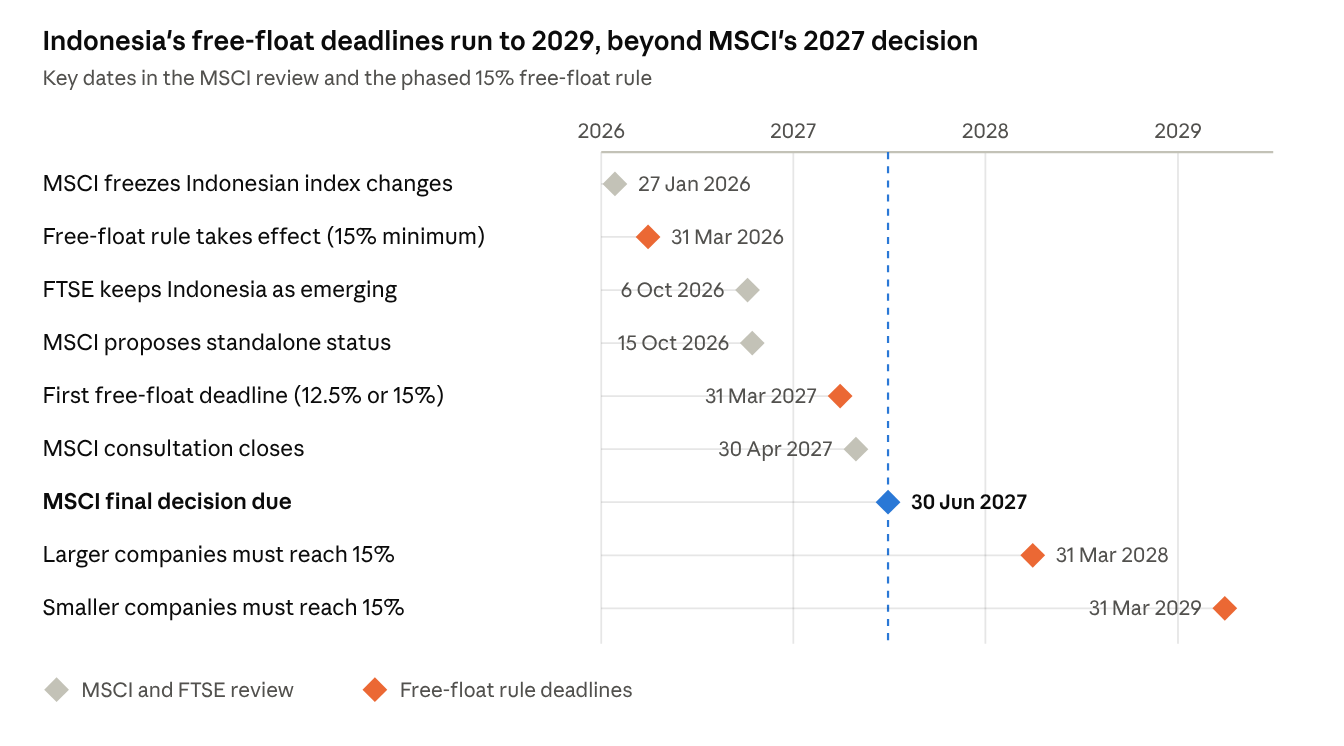
Source: MSCI (15 Oct 2026 announcement and timeline); Bisnis.com (January 2026 freeze); The Financial Coconut (FTSE decision); IDX Channel (free-float deadlines).
Indonesia does not have to choose between an open market and a fair one, but it cannot keep the first for long without the second. So far, financial inclusion has been measured by how many people can buy. The October crash shows it must also be measured by whether they can see what they are buying, and who is selling it to them.
If Indonesia meets its own free-float deadlines and keeps closing manipulation cases on its own schedule, not MSCI’s, it will have done more than save an index label. It will have kept a promise to the 33 million people who have opened investment accounts. That is the lesson for every emerging market chasing financial inclusion, from Jakarta to Ethiopia’s new stock exchange: access gets people into a market, but only transparency keeps them there.
🎧 Listen to the podcast
Conversations with founders, experts and innovators across emerging markets.💬 Follow us on LinkedIn
Join the conversation and get the latest updates. Follow here.📩 Enjoying our content?
Subscribe to Emerging Markets Today and share this edition with your network.
